Singles Day · 23 h left
51% off all posters
There are plenty of good reasons to leave the drill in its box: a rental contract, a concrete wall that shrugs off ordinary nails, or simply not knowing yet where the art should live. None of them has to mean bare walls. Whether a picture can go up without a hole comes down to three things – what you’re hanging, what it weighs and what the wall is made of – and once you know those, the method almost chooses itself. Here’s how we would do it, from adhesive strips and nails to picture ledges and the quiet art of leaning, and when it’s worth fetching the drill after all.
In short
What are you hanging? A poster on its own weighs next to nothing, so a light hold is enough. A framed poster has a frame and glazing to carry, and needs something sturdier.
How heavy is it? Not sure? Stand it on the bathroom scale. That number decides, more than anything else, which method will hold.
What is the wall made of? Anything self-adhesive needs a clean, firm and smooth surface. Wallpaper and plaster are fine; tiles, rough brick and flaking paint are another story.
The table sums up the options. Further down, each one gets a section of its own.
| Method | Best for | Good to know |
|---|---|---|
| Tesa Powerstrips for posters | Posters without a frame | Max. 200 g according to the pack, no visible marks when removed |
| Tesa adhesive nails | Framed posters | 2 kg per nail, 4 kg with two, adjustable height |
| Poster hanger | Posters without a frame | Magnets hold the poster, the strap needs a nail or a hook |
| Picture ledge | Several frames you like to swap | Screws once (included), then no more holes |
| Leaning | Large frames and quick changes | Needs only a sideboard, a shelf, a windowsill or the floor |
| Picture hooks | Hard walls, when a pinprick is fine | A hammer, no drill, nails no thicker than 1.2 mm |
Tesa Powerstrips for posters are double-sided adhesive strips made for paper. One goes on the back of each corner, the poster is pressed to the wall, and that’s it: no drawing pins, no tape and no visible marks when it comes down again – as long as you pull the strips off the right way. Our step-by-step guide to Tesa Powerstrips shows how.
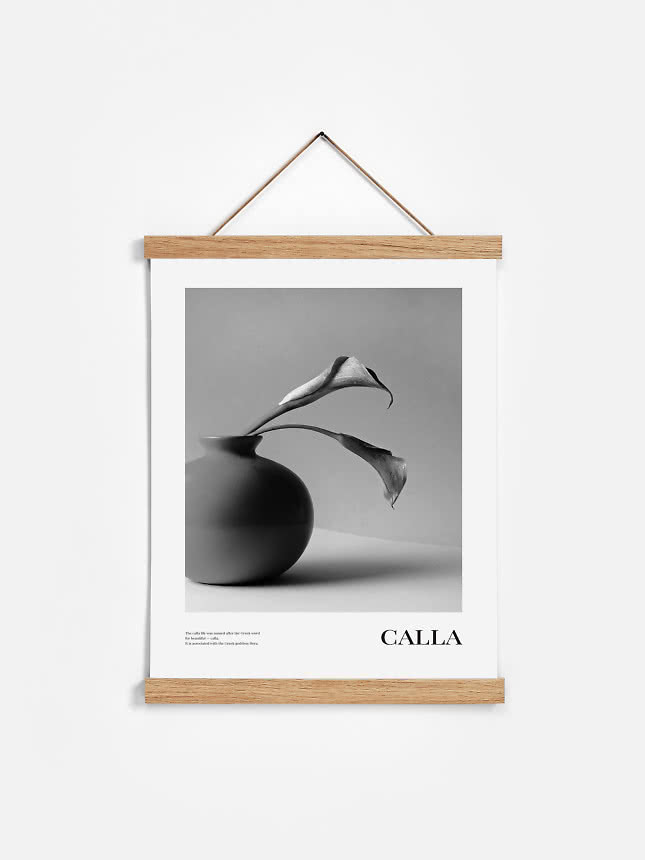
A poster hanger holds the poster between two wooden bars with magnets, top and bottom, and hangs from a strap. The strap needs something to hang from, and a Tesa adhesive nail does the job without a hole. Choose the hanger by the width of the poster: 31 cm for a 30x40 in portrait, 41 cm for a 40x50, and so on. See all our poster hangers.
Poster clips are the most casual of the three: clip them to the top edge and hang them from a nail or a hook. Lovely on a studio wall, above a desk or for a print you already know you’ll change next month.
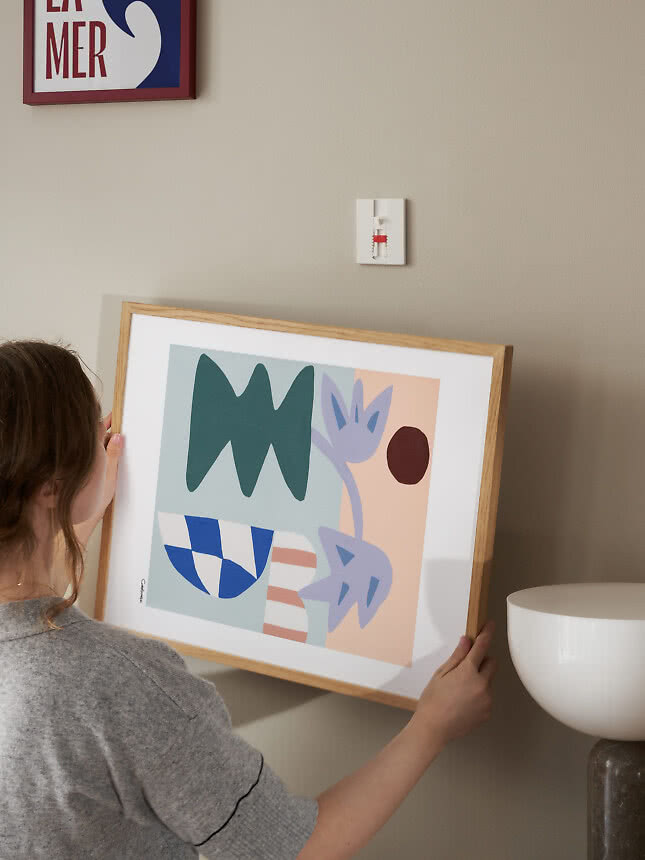
For a framed poster, we reach for Tesa adhesive nails. Each nail sits on a small plate that sticks to the wall with an adhesive strip. One nail holds up to 2 kg, two hold up to 4 kg, and once it’s up you can still move the nail head up or down to line the frame up with its neighbours – handy on a gallery wall. Our wood, aluminium and coloured frames have hangers on the back for both portrait and landscape, so they go straight onto the nail.
When it’s time to move, the strip comes off the wall without a trace, and the nail can be used again with a new adhesive strip. Here’s how to use Tesa adhesive nails, step by step.
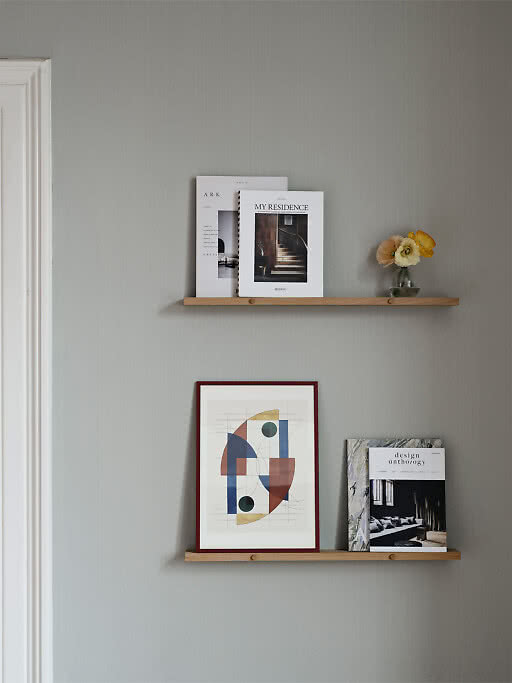
A picture ledge does need screws – ours come with them – but only once. After that, the frames simply stand on it, and you can layer, swap and rearrange without a single new hole. A 70 cm ledge takes two 30x40 side by side, or a 50x70 with a smaller frame in front. If you rent, check what your tenancy allows; one row of holes is far easier to fill than ten. Our picture ledge ideas cover heights, layering and how many frames fit.
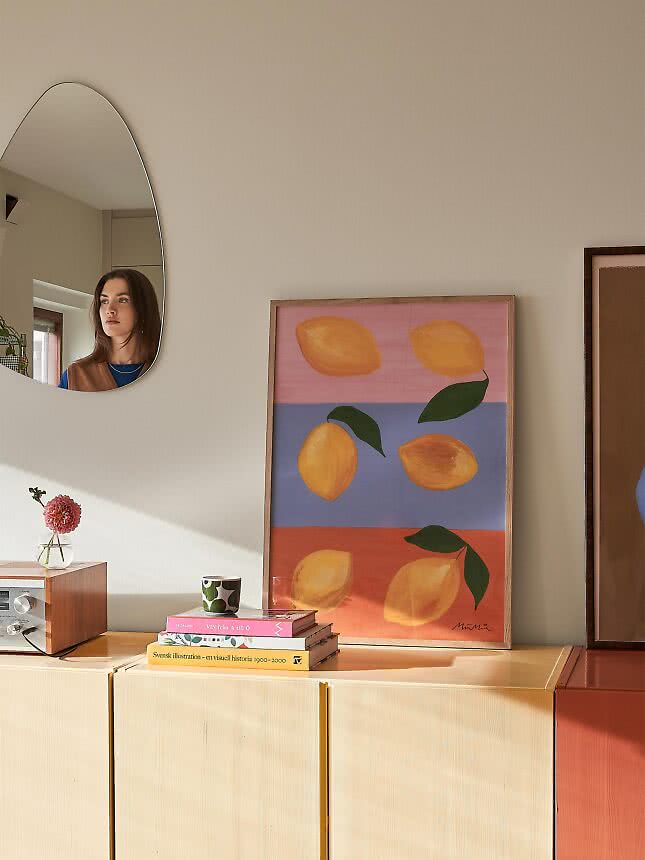
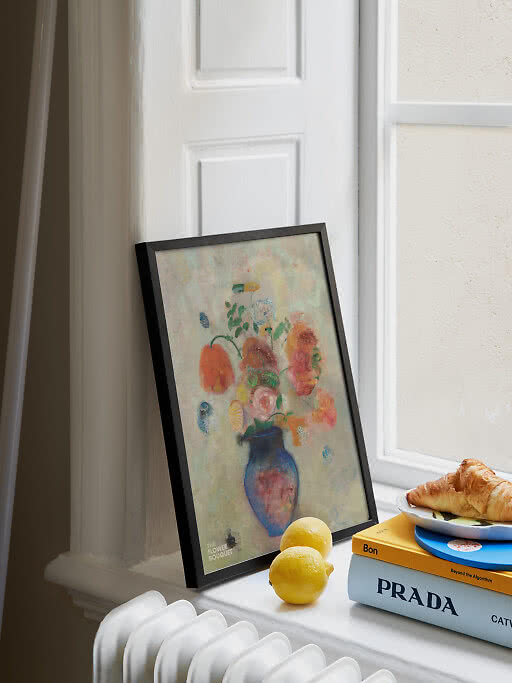
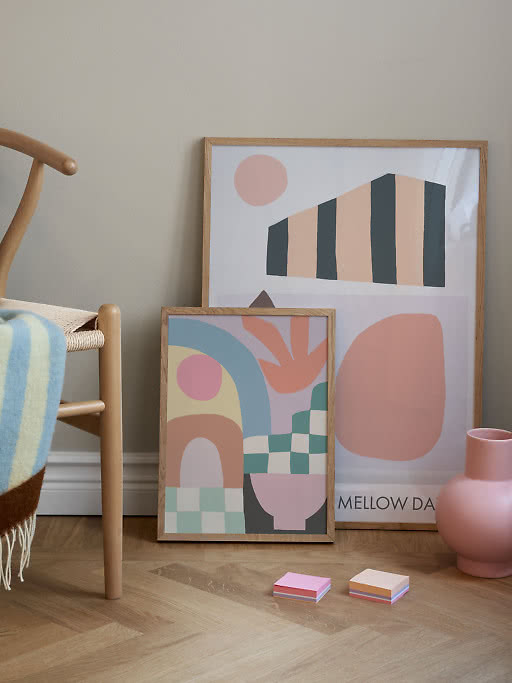
Leaning needs nothing at all. A sideboard, a bookcase, a deep windowsill or the floor will do. Give the frame a gentle tilt, with the bottom edge a few centimetres out from the wall, so it rests securely; on a slippery surface, a small anti-slip pad under the bottom edge stops it creeping. Big frames really come into their own here: a 70x100 or a 100x140 leaning on the floor looks intentional rather than unfinished, especially with a smaller frame in front.
Rather have it on a shelf? A Moebe Pinch is a little stand of two wooden pieces held together by a rubber band. Slip a poster in and it stands on its own, on a desk or a sideboard.
Adhesive is never stronger than the surface underneath it. A quick guide:
| Wall | What works without a drill |
|---|---|
| Plaster, smooth and painted | Tesa poster strips and adhesive nails – both are made for plaster and wallpaper |
| Wallpaper | Strips and nails, as long as the wallpaper itself is firmly stuck |
| Concrete | Picture hooks: thin steel nails you tap in with an ordinary hammer |
| Wood panelling | Picture hooks again – they work in wood too |
| Tiles | The Tesa strips and nails we sell are made for wallpaper and plaster, so stand the art on a shelf, the worktop or the floor |
| Uneven or flaking surfaces | Lean instead – adhesive needs a firm, smooth surface to hold |
Powerstrips: hold the poster with one hand, take the tab of the strip with the other and pull it slowly straight down, along the wall – not out towards you. The arrow on the pack shows the same movement. The strip lets go without visible marks, and the paper comes away unharmed.
Adhesive nails: hold the nail head with one hand, take the tab at the bottom of the strip with the other and pull straight down towards the floor, without pressing the nail against the wall. Keep the nail; with a new adhesive strip, it’s ready for the next wall.
Ledges and picture hooks do leave holes, but small ones. The picture hooks’ nails are no more than 1.2 mm thick, and a ledge leaves one short row – a little filler and they’re gone.
Adhesive and leaning cover most walls, but not every one.
When it’s heavy. If the scale says more than two adhesive nails can carry, a screw and a wall plug are the safe choice.
Above a bed or a sofa. Where someone sits or sleeps underneath, choose a hold that can’t let go: a screw in the wall, or small frames standing well back on a ledge.
When the wall says no. Tiles, rough brick and crumbling plaster give adhesive little to grip. Picture hooks with thin nails work in concrete, wood and gypsum; otherwise, lean.
When it’s your home and the art is staying. In a place you own, a neat hole behind a frame that will hang for years is no drama. Our complete guide to hanging wall art helps you find the right height and spot.
For posters without a frame, use Tesa Powerstrips for posters or a poster hanger. For framed pictures, Tesa adhesive nails hold up to 2 kg each. Or skip the wall altogether and lean the frame on a sideboard, a windowsill or the floor.
Not the poster strips – they’re made for paper. For a frame, use Tesa adhesive nails: one holds up to 2 kg, two up to 4 kg, and our frames hang straight on them by the hanger on the back.
They’re made to come off without visible marks, as long as the wall is firm and you pull the strip slowly straight down along the wall. Loose wallpaper or flaking paint can come away with it, so check the surface first.
With picture hooks that have thin steel nails: you tap them into concrete with an ordinary hammer, and the nails are no more than 1.2 mm thick.
Up to 2 kg per nail, or 4 kg with two. Weigh the framed picture on a bathroom scale before you choose.
It needs screws, but only one row – after that, the frames can change as often as you like without new holes. Check what your tenancy allows first.
Hang it without a drill
More from the magazine
All articles →




 (1).png)